
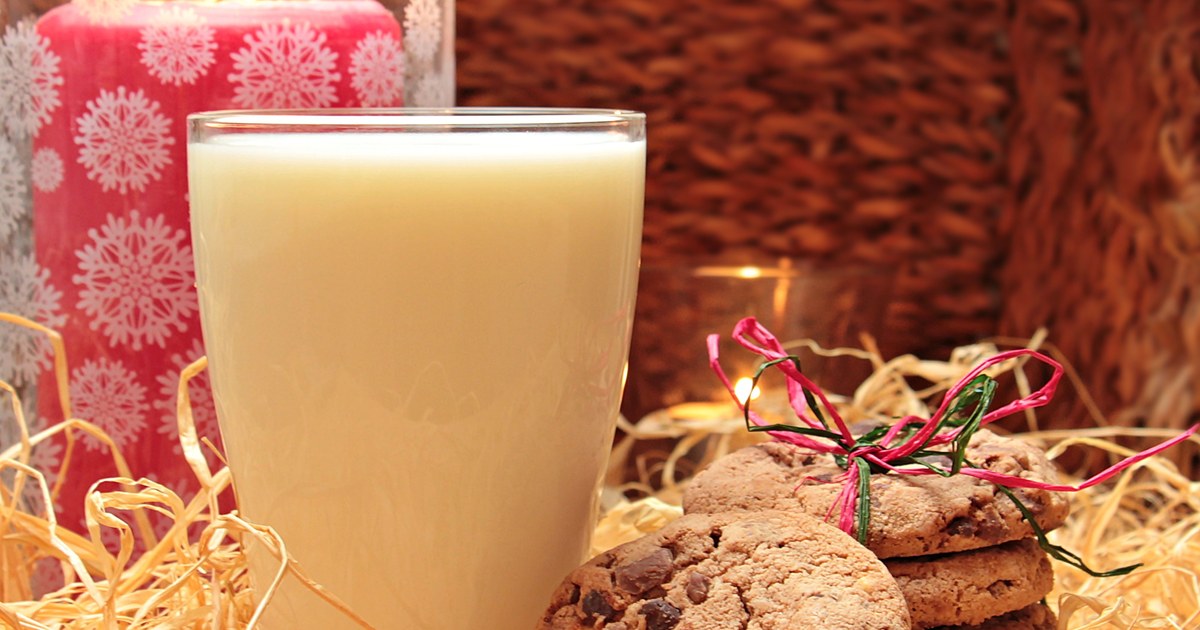
No one has documented who first left cookies and milk for Santa, and we could not find any reliable source that dates it. The closest documented relative is a much older Dutch custom: children putting out a shoe for Sinterklaas, which today holds something for his horse. The American plate of cookies grew up somewhere in that family of customs, without leaving a paper trail.
That is the honest short answer, and it is more interesting than the confident ones. What we can document is how old the gift-for-the-visitor idea is, what the two founding American Santa texts do and do not say, and why one research team studying children’s beliefs singles out cookies and milk for Santa as an example of a ritual that matters.
What is the oldest part of the custom we can document?
The Dutch shoe.
The Meertens Instituut, the Dutch national research institute for language and culture, describes putting out a shoe for Sinterklaas as a centuries-old tradition. Children set a shoe by the hearth or the heater, put something in it for the saint’s horse, sing songs, and find something sweet or a small present in it the next morning. Its ethnologist Irene Stengs notes that the custom goes back to the fifteenth century, when children from poor families could leave a shoe in church on December 5 to be filled by wealthier townspeople. The feast the shoe is put out for, and how little is known about the bishop behind it, is in St. Nicholas Day traditions.
So in its oldest recorded form the shoe was not a snack for anybody. It was a gift waiting to be filled, for children who needed one. The modern Dutch version adds something for the horse, and that is the part closest to the carrot a great many American households now put out beside the cookies. The page does not date the horse food, and we will not guess. The reindeer have their own history, and it is on our reindeer names page.
Do the early American Santa stories mention food?
No, and that is the useful surprise.
The two texts that built the American Santa both leave the kitchen alone. The 1821 picture book The Children’s Friend, the one that gave us the first red coat and the sleigh with REWARDS on its side, is about what Santeclaus leaves, not what he takes. The poem first printed in the Troy Sentinel on December 23, 1823, and later credited to Clement Clarke Moore, follows its visitor down the chimney in some detail. He fills “all the stockings,” turns “with a jirk,” lays a finger beside his nose and is gone. He does not eat a thing. There is not so much as a crumb in either text.
So whatever the cookies are, they are not part of the founding story. They were added later, by households, and nobody wrote down when.
Where do the popular origin stories come from?
Mostly from each other. Two are repeated on almost every page about this, and we could not find an encyclopedic or primary source for any of them:
- The Norse one, in which children left food for the horse of the god Odin. It gets repeated because it sounds ancient. We found no scholarly source that connects it to the American plate of cookies.
- The Great Depression one, in which parents in the 1930s revived the custom to teach gratitude. It is a nice idea, and it may even be true of some families, but we found no study, archive or institutional history that documents it.
We are not saying these are false. We are saying they are unsourced, which on this site means we will not tell them to you as history. A post that confidently gave you an Odin origin would be more satisfying and less true.
Did advertising have anything to do with it?
It kept Santa eating, at least. The Coca-Cola Company’s own history of its Santa campaign says that from 1931 to 1964 its advertising showed Santa pausing to read a letter and enjoy a Coke, and raiding the refrigerators in a number of homes. Thirty years of magazine paintings of a Santa who helps himself in your kitchen is a strong image, and a hungry Santa is exactly the one a plate of cookies is for.
That is as far as the evidence goes. The advertisements show a Santa who snacks. They do not show that anybody started leaving cookies because of them, and it would be the same mistake as the red-coat myth to claim they did.
So why does the ritual matter, if nobody knows where it started?
This is the part that is documented, and well.
One team of psychologists who study how children decide what is real uses cookies and milk as its example. In a 2020 paper in PLoS ONE, Kapitany, Nelson, Burdett and Goldstein point out that many families independently perform the same things for Santa, putting out milk and cookies and a carrot for the reindeer among them, and that these rituals are consistent across households within a culture. They argue that rituals like these act as a kind of evidence for a child: proof that the grown-ups around them take the figure seriously enough to do something about it. In their study of 176 Australian children, figures that came with household rituals, Santa, the Easter Bunny and the Tooth Fairy, were endorsed as more real than storybook characters. The authors are clear that the ritual explanation is a hypothesis they are putting forward, not an effect they measured.
That is worth knowing whichever way your family does Christmas. For a household deep in the Santa story, the plate is one of its most load-bearing parts. For a household that never started, or stopped, the same plate is a lovely ritual in its own right: something the whole family makes together and leaves out for the idea of a visitor, which is roughly what the Dutch shoe was all along.
How do families actually do it?
However they like. Here is what we have seen work, as suggestion rather than rule. If you are fitting the plate into a whole evening with little ones, a Christmas Eve plan for families with small children gives it a slot between an early dinner and bed.
Let the child choose the menu. One cookie that they made, or chose, beats a bakery plate. Some households swap the milk for whatever the child thinks a cold traveler would want.
Add the carrot. It echoes the Dutch shoe with something in it for the horse, the nearest relative of this custom with any documentation, so it has earned its place.
Leave a note, and expect one back. A short thank-you in handwriting nobody in the house can quite place is, in our experience, the part children keep. If you want to know more about Santa’s other paperwork, the history of the naughty or nice list starts in the same 1821 book.
Eat most of it. A half-eaten cookie and a bitten carrot tell a better story than an empty plate.
Once the plate is out and before anyone is in bed, there is often a restless half hour to fill. Xmas Naughty Or Nice Scanner is one way to spend it: a candy-cane frame, a sweep of red light, and a ribbon with a verdict it makes up, delivered out loud. Nothing about anybody is examined, and in our house somebody always insists on pointing it at the plate as well. It is a small one-time purchase on iPhone.
Sources
- Schoen zetten door de eeuwen heen (Putting out the shoe through the centuries), Meertens Instituut, Royal Netherlands Academy of Arts and Sciences, November 2025
- Kapitany R, Nelson N, Burdett ERR, Goldstein TR. The child's pantheon: children's hierarchical belief structure in real and non-real figures. PLoS ONE, 2020
- Account of a Visit from St. Nicholas, as printed in the Troy Sentinel, 23 December 1823
- Haddon Sundblom and the Coca-Cola Santas, The Coca-Cola Company