
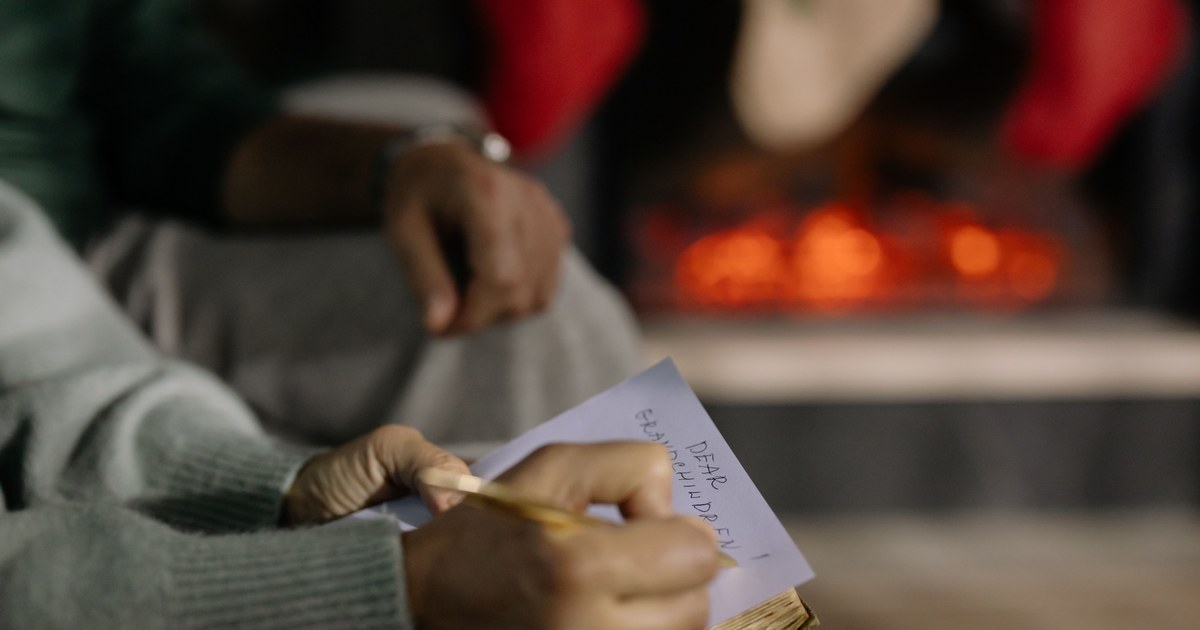
A Christmas scavenger hunt at home needs eight scraps of paper, a pen, a roll of tape and twenty minutes, ideally while the children are busy elsewhere or asleep. Write the clues below, hide them in reverse order, and hand over the first one. The prize at the end should be something everybody shares, so the hunt has no loser.
The rest of this page is the setup, eight rhyming clues you can copy by hand, a picture version for children who cannot read yet, the change that works for a teenager, and a version you can play from the back seat of a car. Nothing needs to be bought or printed.
How do you set it up?
Work backward. This is the whole trick, and it is the part people get wrong.
- Decide the ending first. The last clue leads to the prize. Put the prize there.
- Hide clue 8 somewhere, then write clue 7 so it points to that spot. Keep going back to clue 1.
- Keep clue 1 in your pocket. You hand it over to start.
- Number the back of every clue. When a clue goes missing behind a radiator, you will know which one.
Twenty minutes is enough for eight clues in an ordinary house or apartment. Six is plenty for a four year old. Ten is about the limit before anyone under eight starts to wilt.
What should the prize be?
Something shared, which is a deliberate choice. A single prize for whoever finds it first turns a lovely half hour into a sprint that the smallest child loses. Good shared prizes:
- The makings of hot chocolate, with the mugs already out
- The next Christmas film, with the remote hidden at the finish
- A plate for tonight’s cookies for Santa, if your house does that ritual (the history of it, such as it is, is in why we leave cookies and milk for Santa)
- A nice list certificate for everyone, printed in advance and waiting in a stack
The eight clues
Here are eight example riddles a parent might copy onto paper, one per scrap. They are written for rooms nearly every home has, so swap any that do not fit yours.
Clue 1, for the fridge. “Where the milk keeps cold and the butter stays hard, behind the big door there waits a card.”
Clue 2, for a bed. “The next one is hiding where somebody sleeps. Lift up the pillow and take a quick peep.”
Clue 3, for the bathtub. “Where the rubber ducks float and the bubbles go pop, the next little note is waiting on top.”
Clue 4, for the bookshelf. “Stories are sleeping in rows on a shelf. The fattest one holds a clue in itself.”
Clue 5, for the shoes by the door. “Where boots are kicked off and the wet socks go, a clue is tucked in a shoe, right down in the toe.”
Clue 6, for the tree, or a houseplant in a house without one. “It is green, it is tall, it lives in a pot. Under its branches is the next clue’s spot.”
Clue 7, for the washing machine. “It spins and it rumbles and it eats all the socks. Look near the machine where the laundry drops.”
Clue 8, for wherever the prize is. This one depends on where the prize is, so adapt it. Two that work: “High and low the hunters have been. The prize is waiting where the dinner is seen,” for the kitchen table, or “Last clue of all, and nothing to fear: the prize is on the sofa, right over here.” Keep it short. By now everybody is shouting.
What about children who cannot read yet?
Draw the clues instead. A rough rectangle with a handle is the fridge. A bath with three wavy lines is the bath. Nobody needs to be good at drawing, and a child working out that the lumpy thing is the washing machine is doing exactly the kind of thinking the American Academy of Pediatrics has in mind when it talks about play building symbolic thought: working out that one thing can stand for another.
If you have a reader and a non-reader, pair them. The reader reads the clue aloud, the younger child is in charge of running to the spot first. Both are necessary, and both know it.
How do you keep it fair with more than one child?
Two good ways.
One trail, everybody together. The simplest. The group reads each clue together and moves as a pack. Give the youngest the job of opening each hiding place.
Separate trails, same ending. Write each child’s clues on a different colored paper, or mark them with a different symbol, and make the trails the same length. Everybody arrives at the same prize at about the same time. It takes twice as long to set up, and in a house with a competitive seven year old it is worth every minute.
Either way, nobody wins and nobody loses. The 2018 American Academy of Pediatrics clinical report on play by Yogman and colleagues, a review of the evidence rather than a single trial, describes the shared back and forth of play between parents and children as good for them in its own right. A hunt where everyone reaches the hot chocolate together gets plenty of that, without a meltdown in the hallway.
Where should you not hide clues?
A few places are worth avoiding, for boring and sensible reasons:
- Anywhere near the oven, the fireplace or a heater. Obvious once you think about it, less obvious to a child running at full speed.
- Among light-up decorations or small electronics. The AAP’s HealthyChildren.org warns that button batteries turn up at this time of year in lighted wreaths, garlands, flameless candles, ornaments, musical cards and remote controls, and that swallowed batteries can cause serious injury. A clue hunt sends small hands into exactly those places, so keep the trail well away from them.
- High shelves. Nothing that requires climbing.
- Outside after dark. Save the garden for a daylight hunt.
What about a teenager?
Hand them the pen. Teenagers are often too cool to hunt and delighted to set a hunt, especially for younger cousins, and they write better clues than we do. Ask for cryptic ones. You will get riddles about the washing machine that would not embarrass a crossword.
For a teenager who does want to play, reverse the whole thing: they hide something of yours, and you follow their clues. It is humbling.
Is there a version for the car?
Yes, and it needs no paper at all. Before you set off, agree on a list of things to spot out of the window on the way, said aloud: a wreath on a door, a roof with lights on it, an inflatable snowman, a Christmas tree in a window, a car with antlers, someone walking a dog in a festive sweater. The whole car is one team. When the list is done, the driver picks the prize for the first stop.
If you liked this, Christmas games that need nothing but a pen and paper has six more for the same kind of evening.
One more idea for the finish line. Some families hide the phone with the last clue and end the hunt with Xmas Naughty Or Nice Scanner: it frames each hunter’s face in candy-cane stripes, sweeps a red line across it and announces an invented verdict on a ribbon, which is a fitting ceremony for people who just found eight clues. Nothing about anybody is examined. It is a small one-time purchase on iPhone.
Sources
- Yogman M, Garner A, Hutchinson J, Hirsh-Pasek K, Golinkoff RM. The Power of Play: A Pediatric Role in Enhancing Development in Young Children. Pediatrics, 2018, 142(3), e20182058
- Small Battery Safety at Home: A Winter Holiday Walkthrough, American Academy of Pediatrics, HealthyChildren.org
- Pretend Play: Ways Children Can Exercise Their Imagination, American Academy of Pediatrics, HealthyChildren.org